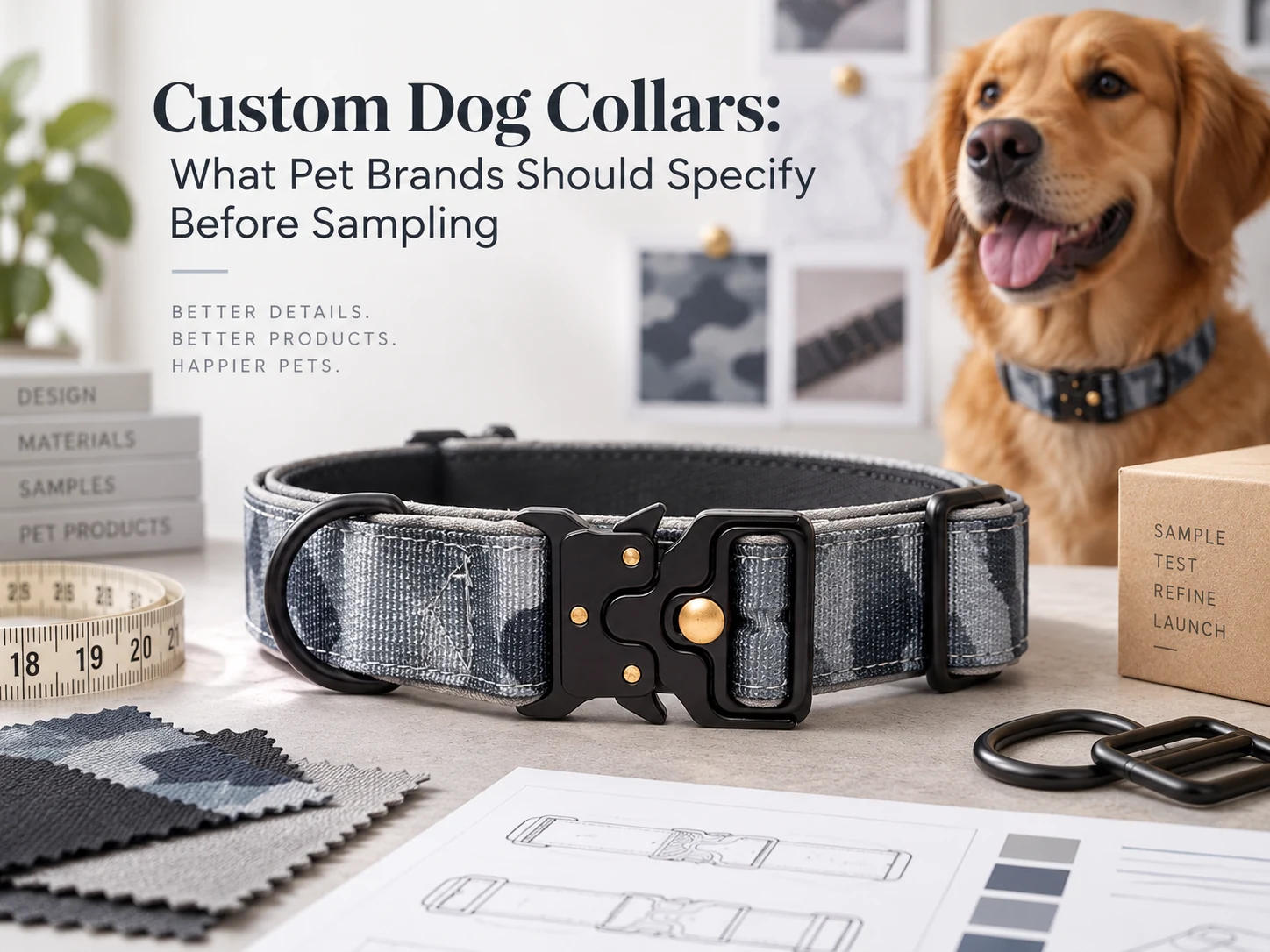
A brand rarely starts a customization project because it wants something prettier. It starts because the stock collar in its range does not match the brand’s look, or because the size curve does not fit the dogs its customers actually own. The first sample is where that decision gets tested, and a sample built from a vague brief mostly tests the factory’s patience.
Almost everything below can be changed on paper for free. Two items cannot be changed cheaply once a sample is approved: the hardware and the size curve. That is the order this works in.
What Customization Actually Changes
Custom work on a collar is mostly a set of choices about parts. Getting those three answers early usually saves a sample round or two.
Materials and Webbing
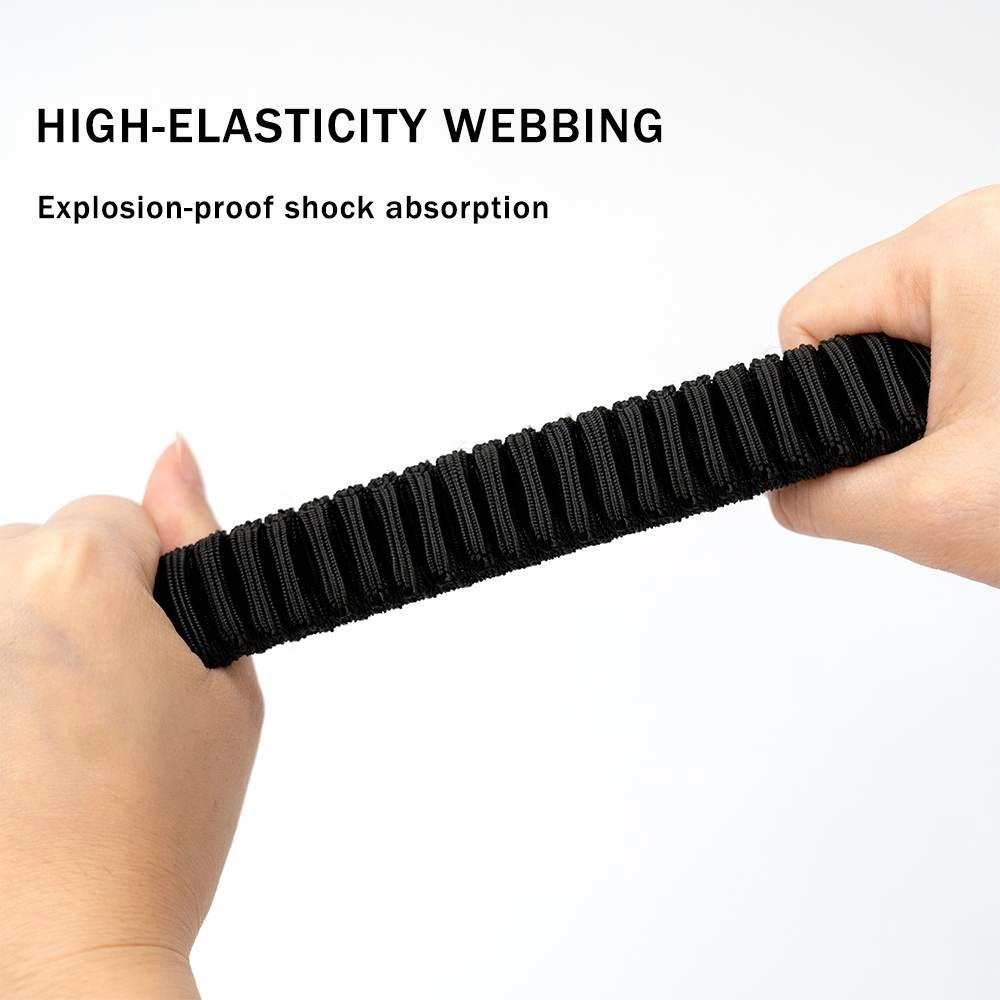
The outer layer decides how the collar survives a summer. A camouflage reflective collar and tether set, for instance, pairs a high-strength polyester camouflage outer fabric with a skin-friendly inner lining, and the reflective strips sit in the collar itself rather than on a tag that can be lost. On a pet collar the lining is not a detail — it is the surface that touches a neck for hours, and it is the first thing a buyer notices when a sample is compared against a cheaper one on the same table.
Numbers are more useful than adjectives here. The webbing on that set carries a static pulling force of over 80 kg, and the reflective effect is expected to last one to two years under normal use. A brand can repeat those figures in its own product copy; it cannot repeat “premium quality” and expect anyone to care.
Hardware and Closure
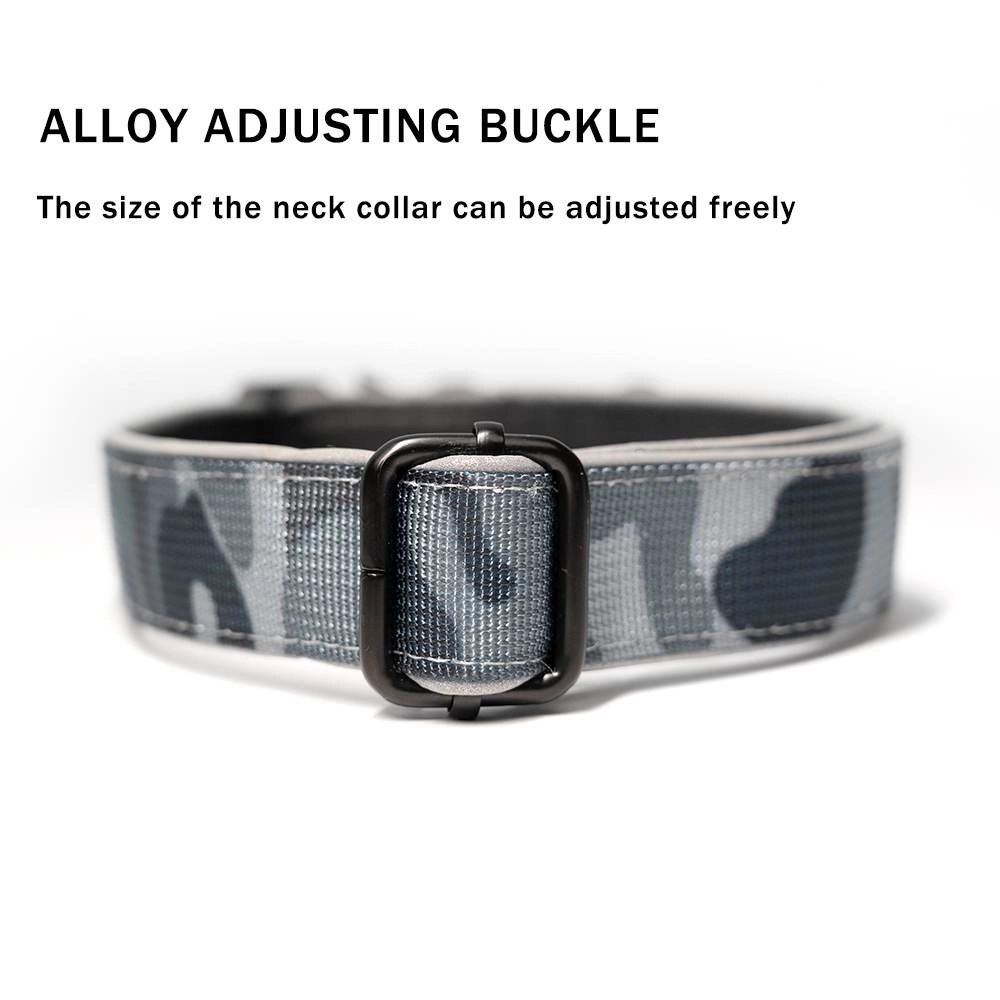
Here is where a range quietly succeeds or fails. Zinc alloy fasteners keep their seat under load, and the finish has to survive rain and salt rather than only the showroom. The closure choice carries its own message: a one-click quick-release buckle reads as convenience, while a traditional buckle reads as security. Whichever direction a brand picks, it should be fixed before the sample is built, because swapping hardware later touches the webbing, the stitching pattern, and often the size curve as well.
Logo and Name Details
Logo printing through embroidery or sublimation covers most brand-differentiation requests, and colour customization usually travels with it. The constraint is space. A collar strap is narrow, so the real questions are how wide a logo can run, how far it sits from the buckle and the adjuster, and whether a name plate or ID detail will fight it for the same few centimetres. Companies that build several collar and harness programmes can see those options laid out together on the OEM and ODM page, which helps a brand commit to one direction instead of reopening artwork later.
The Size Curve Comes Before the Design
A collar that fits one dog is a prototype. A range that fits a market is a product.
Measuring and Size Ranges
Where dog collar sizes are concerned, measured neck circumferences beat breed names every time, because two dogs with the same label can differ by several centimetres around the neck. A common three-size curve runs 20-35 cm, 30-50 cm and 40-65 cm — wide enough for most medium and large dogs, short enough to forecast. The adjustment inside each size matters as much as the size itself: buyers usually settle on a size 5-10 cm larger than the measured neck circumference, which keeps the collar comfortable without letting it slip over the head. Harness programmes repeat the same exercise against chest girth on a pet harness, and although the numbers differ, the method does not.
Where a Standard Curve Stops Working
Some markets need proportions a three-size curve cannot reach. It is also the reason the dog collar sizes printed on a retail page should be checked against real dogs before a range is locked. Bespoke sizing is the usual route for unusual shapes and for working or assistance contexts such as service dogs and senior pets. Treat those requests as a signal rather than an inconvenience: a brand that keeps receiving the same unusual measurement has found a gap it can own, and a factory that can build that size once can build it every season.
What to Put in the First Brief
A brief written in the right order saves a sample cycle. It needs the product and its size curve, the material and hardware direction, colour and logo requirements, any functional additions such as reflective strips or handles, packaging, the destination market, and the quantity the brand expects to order. The destination market deserves more attention than it usually gets, because it decides which safety and labelling expectations apply to the materials and how the packaging is planned. For private label pet products the packaging decision tends to arrive earlier than it does for a stock range, since artwork has to be signed off before the bulk run starts.
Order Terms to Confirm Early
The commercial terms decide whether a design turns into a repeat programme. Standard minimum order quantity starts at 300 units per design. Custom samples are typically ready within 7-10 days, bulk production generally runs 30-45 days depending on complexity, and expedited production is available for urgent requests. Materials are described as compliant with international safety standards such as CE and ASTM F963, and a wholesale dog collars programme follows the same sampling and approval route as a brand’s own line. Get those numbers in writing before sampling starts; a brand that plans a launch around a sample date and only then discovers the bulk window has a problem no design work can fix.
Capacity belongs in the same conversation. The facility behind the range covers 14,000 square metres, runs four assembly lines with more than 400 precision machines, and ships to customers in more than 40 countries. That is the difference between a supplier that can repeat an approved sample and one that cannot.
How to Check the First Sample
Judge the sample the way a customer will, not the way a spec sheet reads. Webbing should feel dense between two fingers rather than merely look dark. Every buckle and adjuster should be opened and closed several times, because hardware that seats firmly on the first attempt can still rattle after sizing. Where the lining meets the dog, look for folding and rough edges; around the attachment points, look at how the stitching is finished rather than how much of it there is. If the design includes reflective strips, compare the exposed area once the collar is fitted — a flat photograph hides exactly the problem the strip is meant to solve. Then measure the sample against the size curve, since a sample that only fits the middle of a range will produce returns at both ends.
Conclusion
Building custom dog collars is a specification exercise long before it is a design exercise. Fix the material and hardware, place the logo where the strap can actually hold it, define a size curve that covers the market without inventing extra SKUs, and confirm the commercial terms before the first sample exists. Brands that work in that order end up with a sample they can put in front of buyers; brands that start with artwork usually pay for the same lesson in extra rounds. Send the intended size curve, the material and hardware direction, the colour and logo files, the packaging plan and the expected quantity, and the Holydog team can turn that brief into a sample specification for collars, harnesses and leashes.
FAQs
Q1: What is the difference between a personalized dog collar and a custom one?
A1: A personalized dog collar usually adds a name, a tag or a logo to a construction that already exists. Custom work changes the build itself: the outer fabric and lining, the hardware and closure, the colour, and the sizes the range is sold in. Most brand programmes need both, which is why the specification order starts with material and hardware instead of artwork.
Q2: How many sizes should a first collar range include?
A2: Three sizes are enough for most first ranges, covering roughly 20-35 cm, 30-50 cm and 40-65 cm of neck circumference. What matters more is where the curve sits. Sellers serving small-breed owners can compress it, while those covering working dogs may keep the full span and add bespoke sizing for the measurements that fall outside it.
Q3: Do wholesale dog collars programmes need a different brief?
A3: They need the same information with two additions. State the quantity you expect per size instead of one total, and say whether the packaging is going to retail shelves or to a distributor in bulk. Both answers change how the order is planned, and neither can be guessed from a product photo or a private label pet products catalogue.