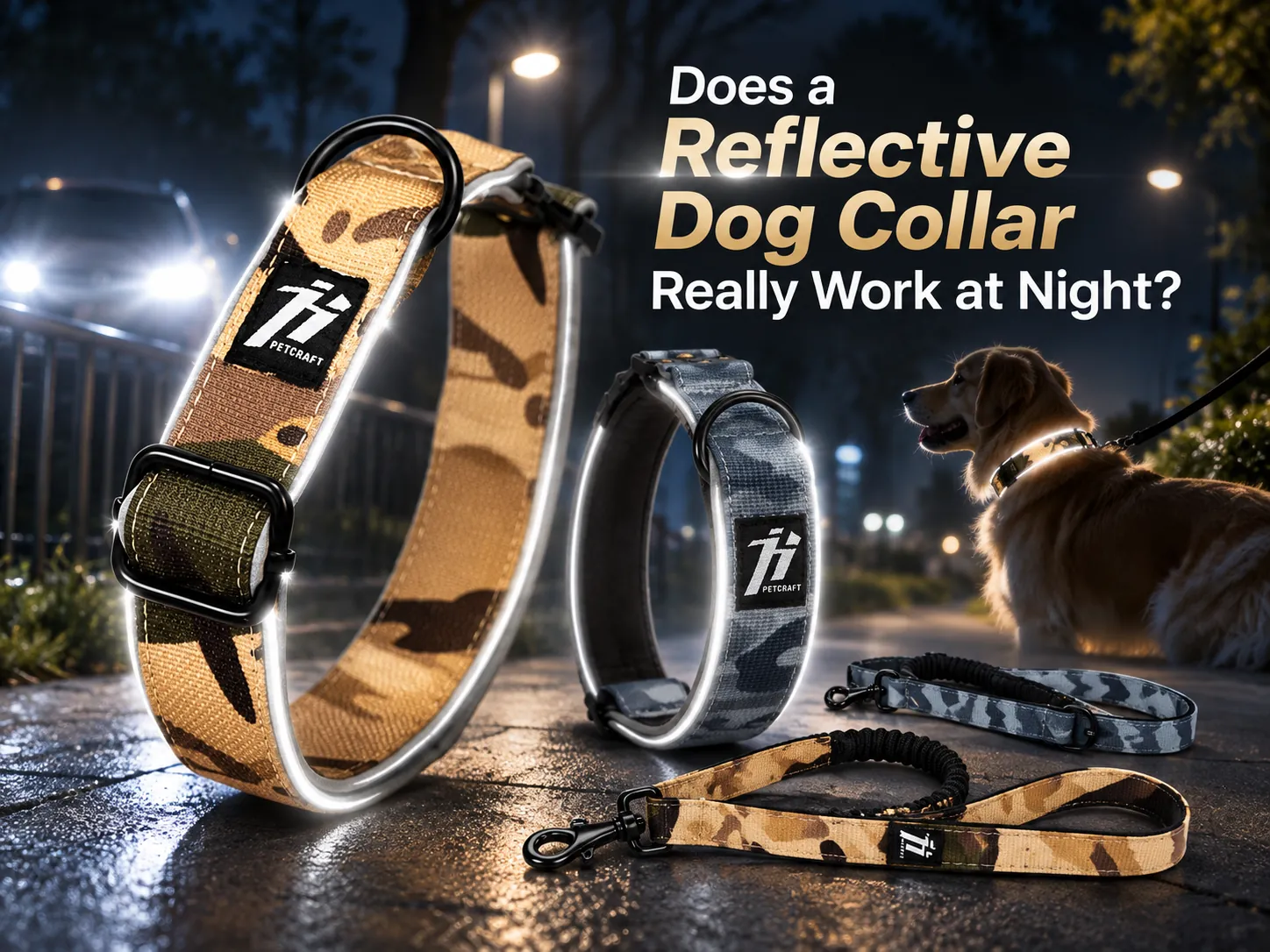
A dog can be easy to see under a porch light and almost disappear once the walk reaches a darker street. That is why a reflective dog collar can be useful—but the word “reflective” on a product label does not tell you how well it will perform during an actual walk. What matters is whether the reflective material can catch incoming light while the collar is fitted on a moving dog. Fur can cover it. A loose collar can rotate. Buckles and adjusters can interrupt the reflective area. Even the route itself matters because reflective material needs an outside light source.
For dog owners, knowing these details makes it much easier to choose useful night-walking gear. For pet brands and buyers, they also provide a practical way to evaluate reflective dog collars beyond appearance and marketing claims.
How Does a Reflective Dog Collar Actually Work at Night?
Reflective material is passive; it does not emit light on its own. Instead, it returns light that reaches its surface.
Headlights, bicycle lamps, streetlights, and flashlights can make the collar appear brighter to an observer close to the source of that light. For that reason, reflective gear has a clear role on streets where vehicles, cyclists, or other light sources are present.
However, the same collar may look far less noticeable on a completely dark trail with little incoming light.
Dog visibility depends on the exposed reflective surface and the surrounding lighting conditions, rather than on the word “reflective” alone.
Incoming Light Has to Reach the Reflective Surface
Imagine a car approaching from the side. The section of the collar facing the vehicle matters most.
When the collar turns and its reflective section moves beneath the dog’s neck, approaching headlights may reach less of the material. The same problem can happen when long fur covers part of the collar.
This is one reason a reflective collar should be evaluated after it has been fitted on the dog rather than judged only from a flat product photo.
Reflective Coverage Matters More Than the Label
Two reflective dog collars can both be sold as reflective while providing very different usable reflective areas.
One may have only a thin decorative line. Another may use reflective edging around a larger portion of the webbing.
When comparing collars, look at:
- how wide the reflective section is;
- how far it runs around the collar;
- whether the buckle interrupts it;
- whether an adjustment buckle covers it after sizing;
- whether it stays visible when the collar rotates slightly.
A larger reflective area is not automatically perfect, but it usually gives incoming light more opportunities to reach an exposed surface.
What Can Reduce Dog Visibility During a Real Walk?
The difference between a collar sitting on a table and a collar moving on a dog is larger than it first appears.
Fit, coat length, surface condition, and hardware position can all affect how much reflective material remains exposed.
Collar Rotation Can Hide the Reflective Area
A collar that is too loose may rotate as the dog turns, pulls, lowers its head, or changes direction.
This can move the most reflective section away from approaching traffic or underneath the neck. A properly adjusted collar should remain comfortable while staying stable enough that its functional surfaces do not continually disappear.
This makes fit part of dog walking safety rather than only a comfort issue.
Recheck the adjustment after weight changes or when the seasonal coat becomes noticeably thicker.
Long Fur Can Cover Reflective Material
A wide reflective strip cannot return much light if most of it sits underneath dense fur.
With a long coat, assess the collar after the fur has settled into its normal position. Adding a reflective dog leash or harness can enlarge that visible outline in some setups.
The goal is not to cover a dog in reflective equipment. It is to make important parts of the dog’s outline easier to notice from realistic viewing angles.
Dirt and Wear Can Change the Exposed Surface
Outdoor collars deal with mud, dust, sand, moisture, and repeated rubbing.
If dirt covers the reflective strip, less of its surface remains exposed. Frequent folding or damaged stitching may alter the position of the strip.
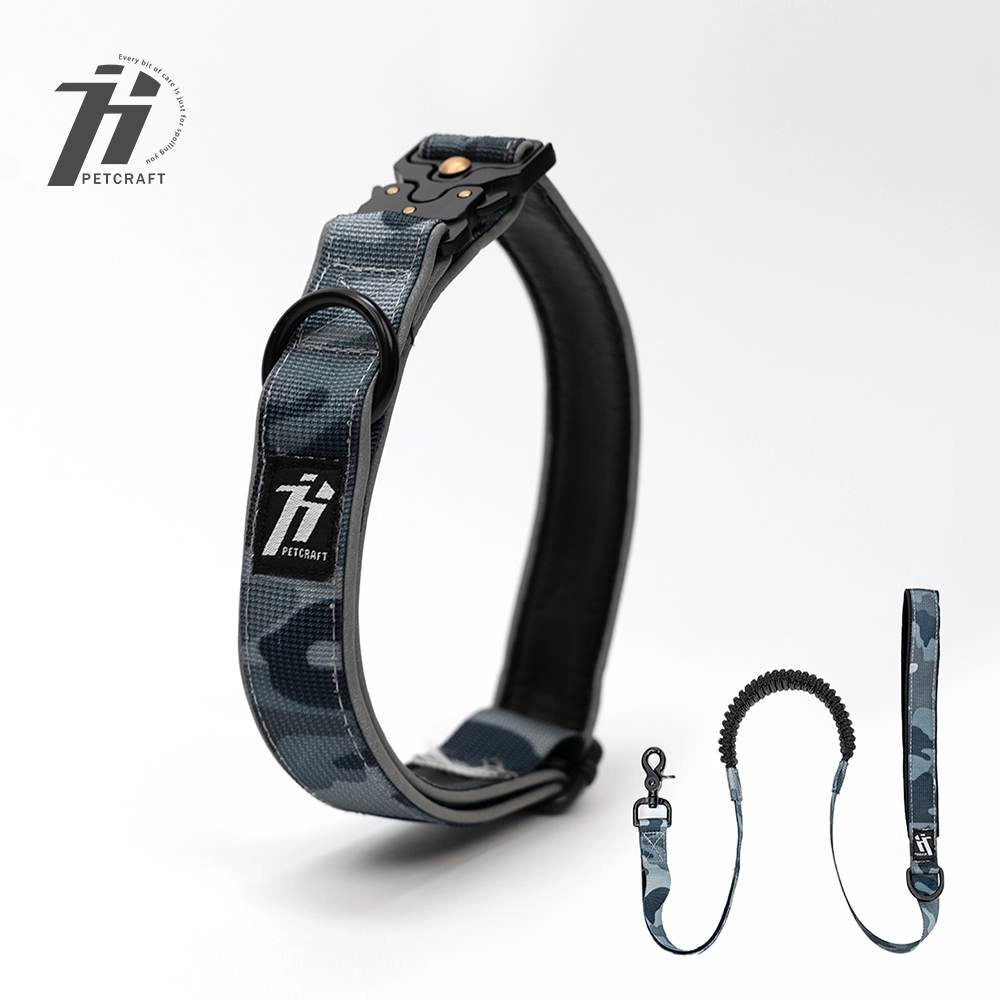
Inspect the collar before an evening walk so these conditions are found early. The reflective strip on the camouflage reflective collar and tether set uses a high-brightness material that is not easily worn out in daily use, and its reflective effect is expected to last one to two years under normal conditions.
The camouflage reflective collar and tether set in this range answers the wear question with a specific build: a high-strength polyester camouflage outer fabric, a skin-friendly inner lining, and reflective strips that form part of the collar rather than a separate accessory.
Zinc alloy fasteners hold the set together, and the webbing carries a static pulling force of over 80 kg, which covers the medium and large dogs between 20 kg and 50 kg that the set is sized for.
Owners and pet-product buyers can compare the camouflage reflective collar and tether set with other constructions in the Holydog pet collar collection rather than selecting a collar only by color or appearance.
How Can You Test a Reflective Collar Before a Night Walk?
A useful test does not require specialist equipment.
The aim is simply to recreate the conditions that can cause a collar to look different once it is being worn.
Check It From Several Angles
Fit the collar normally. Do not rotate the reflective strip toward the camera or flashlight just to make it look brighter.
From several meters away, direct a light toward the dog from the front, side, and rear-quarter positions.
Then look for four things:
- Is the reflective area easy to see?
- Does fur cover part of it?
- Does the buckle block a large section?
- Does the collar rotate when the dog moves?
This gives a much more useful answer than shining a light directly at a collar lying flat on a table.
Repeat the Test After the Dog Moves
Let the dog walk, turn, sniff, and lower its head. Then repeat the visibility check.
This second check matters because a collar can start in a good position and shift after only a few minutes of movement.
The camouflage reflective collar and tether set is sized for medium and large dogs between 20 kg and 50 kg and comes in three neck-circumference ranges:
S: 20–35 cm M: 30–50 cm L: 40–65 cm
The matching tether is 1.5 m long and contains an elastic buffer section that stretches by roughly 10-15 cm when the dog pulls suddenly.
The reflective strips are intended to improve visibility during evening and early-morning walks, and the sizing guidance recommends choosing a size 5-10 cm larger than the measured neck circumference so the collar stays comfortable and is not easily pulled off.
Buyers comparing reflective performance with outdoor durability can also read the tactical dog collar guide for additional guidance on materials, hardware, and outdoor use.
Is a Light Up Dog Collar Better Than a Reflective Collar?
Reflective collars and light up dog collars address the same basic problem in different ways.
Reflective material depends on incoming light. A light up dog collar creates its own visible light, usually through LEDs or another powered lighting system.
Neither approach is automatically better for every walk.
Reflective Gear Works Well Around External Light Sources
Reflective dog collars are most useful where headlights, streetlights, bicycle lamps, or flashlights can reach the dog. Equipment such as a reflective dog leash adds another surface that can catch those light sources.
There is no battery routine to manage, and the reflective feature can be integrated into a normal collar that is already being used for walking.
For urban and suburban routes, this makes reflective equipment a practical way to improve dog visibility without adding much complexity to the owner’s routine.
Active Light Can Add Visibility on Very Dark Routes
On routes with almost no outside illumination, including rural paths, campsites, open fields, and poorly lit trails, a light up dog collar can add visibility.
The better format depends on the environment used for most walks, not on a universal ranking.
Where passing headlights and other light sources are common, reflective surfaces have a clear role. Where outside light is limited, active lighting can provide another layer of visibility.
The same principle applies to dog walking safety more broadly: choose equipment around the real environment instead of relying on a single feature to suit every situation.
What Should Brands Check Before Ordering Reflective Dog Collars?
For retail buyers, “reflective” should be treated as a product specification that can be inspected.
The approved sample should show not only the correct color and branding but also how the reflective feature behaves after sizing and fitting.
Inspect the Finished Reflective Area
Begin by inspecting the sample under ordinary daylight.
Check strip width and alignment, stitch quality, buckle position, adjustment range, and the reflective area still exposed after sizing.
Follow that inspection with a low-light test.
Place the collar on a correctly sized dog or fitting form, then illuminate it from several directions. This test reveals whether the buckle, adjuster, fur, or collar rotation blocks the reflective area.
Logo printing, either embroidery or sublimation, and color customization are available for brand differentiation, and reflective strips can be added as a functional accessory. That means branding and reflective placement can be planned together during sample development rather than competing for the same narrow section of webbing.
Brands developing private-label reflective dog collars can use Holydog customization support to discuss materials, sizing, color, logo placement, packaging, and other functional details before bulk production.
Check the Construction Behind the Reflective Feature
Reflective trim is only one part of the finished product.
A dependable collar also needs stable stitching, suitable webbing, reliable hardware, repeatable assembly, and inspection procedures that help the production batch remain consistent with the approved sample.
The manufacturing base behind the brand is Hangzhou Zhenghong Petcraft Co., Ltd., which describes more than twenty years in the pet-products industry.
The facility covers 14,000 square meters, runs four assembly lines with more than 400 precision machines, and ships to customers in more than 40 countries.
Its materials are described as compliant with international safety standards such as CE and ASTM F963, and an in-house research and development center supports product development.
These resources matter for buyers because reflective placement, stitching, buckle assembly, sizing, and logo customization all need to be reproduced consistently after the approved sample moves into bulk production.
Customized pet collars, harnesses, leashes, and related products start at a standard minimum order quantity of 300 units per design. Sample orders normally take 7–10 days, while bulk orders generally require 30–45 days depending on project complexity.
A brand planning a reflective walking range can contact Holydog with its target dog sizes, color direction, logo requirements, packaging requirements, and intended use scenarios. Giving these details early allows the sample to be evaluated against the actual retail brief rather than only its appearance.
Conclusion
A reflective dog collar can make a meaningful difference at night when the reflective surface receives outside light and remains visible as the dog moves.
The most useful way to judge one is not to ask only whether it contains reflective material. Check how much of that material stays exposed, whether the collar rotates, whether fur covers it, how the hardware affects the reflective area, and what type of lighting is normally available on the walking route.
Owners can use a flashlight from several angles to find issues before the next evening walk.
For pet brands, dog walking safety should be considered during product development. Reflective placement, webbing, sizing, hardware, stitching, and sample inspection work best when they are evaluated together. That is how dog visibility becomes a practical product feature rather than just another line in a specification sheet.
FAQs
Q1: Do reflective dog collars glow in complete darkness?
A1: No. A reflective dog collar sends back light that reaches its reflective surface. They perform best when headlights, streetlights, bicycle lamps, or flashlights supply incoming light. Where little external light is available, a light up dog collar supplies an added visible source.
Q2: How can I tell whether a reflective dog collar is visible enough?
A2: Fit the collar normally and check it from several meters away with a flashlight from the front, side, and rear-quarter directions. Let the dog move and repeat the test. Good dog visibility depends on the reflective area remaining exposed rather than rotating underneath the neck or being covered by fur.
Q3: What should a brand inspect on a reflective collar sample?
A3: Check reflective-strip width and placement, stitching, buckle and adjuster positions, sizing stability, hardware, and visibility after the collar has been fitted. A useful sample inspection should consider both appearance and dog walking safety under realistic low-light conditions.